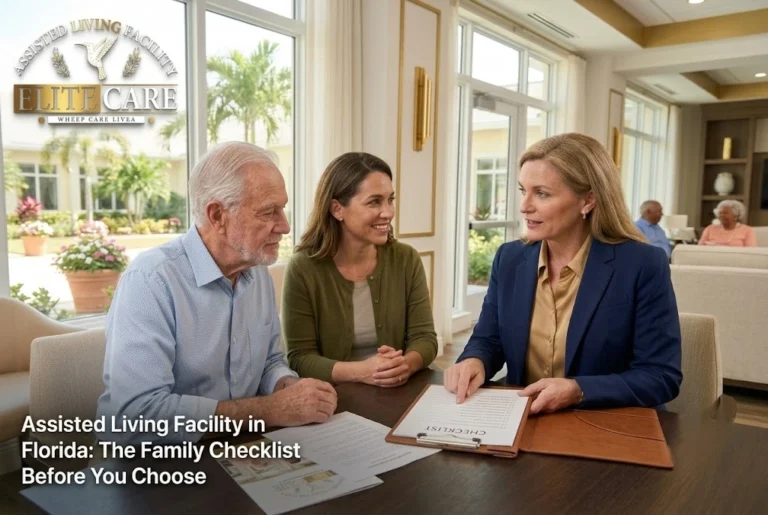
The right assisted living accommodation comes down to three things families can actually verify: a current state license, a staffing ratio the community will state in writing, and a room type that fits your loved one’s mobility and budget. Everything else — décor, activity calendars, dining menus — matters, but only after those three checks pass.
This guide is for adult children and spouses who are comparing communities for the first time and don’t yet know which questions separate a well-run facility from one that just looks good on a tour. By the end, you’ll have a working checklist you can bring to every visit, plus the specific numbers: average cost, typical room sizes, and staffing benchmarks that most facility websites leave out.
👉 Ready to talk it through with a real person instead of a brochure?Request a free consultation with our care team, and we’ll walk you through your loved one’s specific needs—no obligation.
What Does “Assisted Living Accommodation” Actually Mean?
It’s licensed housing that combines a private or semi-private living space with help for daily tasks—bathing, dressing, medication reminders—while leaving as much independence in place as possible.
That’s the line families most often blur. An assisted living accommodation is not a nursing home, and it’s not simply “senior housing.” Nursing homes are licensed for ongoing skilled nursing and rehabilitation; assisted living is licensed for personal care support layered on top of independent daily life. If your loved one is still managing most of their day but needs a hand with a few specific tasks, assisted living is usually the right tier — not the more intensive (and more expensive) skilled nursing setting.
If you’re still weighing this against keeping a parent at home with outside help, our breakdown of assisted living versus home care walks through the cost and safety trade-offs in detail. And if memory loss is part of the picture, our assisted living vs. memory care comparison covers how that changes the equation.
How Do You Know It’s the Right Time?
Watch for a pattern, not a single incident—repeated missed medications, a fall, sudden weight loss, or withdrawal from activities they used to enjoy.
Families rarely make this call after one bad day. It’s usually a pattern that adds up over a few months:
Difficulty managing daily tasks like bathing, cooking, or medication
Increased forgetfulness or confusion, especially around appointments or bills
Isolation or withdrawal from social activities they used to enjoy
Frequent falls or new mobility challenges
Unexplained weight loss or signs of poor nutrition
If two or more of these sound familiar, it’s worth starting the conversation now rather than waiting for a crisis. Our full breakdown of signs an elderly parent needs assisted living—and how to actually have that conversation—goes deeper on each one.
What Should You Verify Before You Even Book a Tour?
Confirm the facility’s active state license and ask for its current staffing ratio in writing—both are public information, and both are nonnegotiable.
This is the step most “top 10 tips” articles skip, and it’s the one with the highest information value. In Florida, assisted living facilities are licensed and inspected by the Agency for Health Care Administration (AHCA). Every facility’s license status, capacity, and inspection history are searchable through AHCA’s public database before you ever set foot on the property—and it’s the single fastest way to eliminate a facility from your list.
In our experience, the second question that separates a strong community from a mediocre one is staffing ratio by shift, not just headline “24/7 staff” language. A comfortable facility stating its daytime and overnight ratios—and able to explain how those numbers change during flu season or a staff callout—is telling you it actually tracks this, not just claims it. Ask this exact question on your tour: “What’s your caregiver-to-resident ratio right now, on this shift?” A confident, specific answer is a good sign. A vague one isn’t.
What Do Assisted Living Rooms and Amenities Actually Look Like?
Most communities offer a mix of private studios, semi-private (shared) rooms, and larger one-bedroom suites—and the difference in monthly cost between them is usually several hundred dollars.
Room Type
Typical Layout
Best For
Semi-Private Suite
Shared room, private closet/storage, shared or private bath
Budget-conscious families, residents who prefer company
Private Studio
Single-occupancy room with private bath
Residents who want independence with support close by
One-Bedroom Suite
Separate bedroom and living area
Couples, or residents with more mobility equipment
Beyond the room itself, look at the communal spaces: dining areas, activity rooms, and outdoor gardens all affect day-to-day quality of life as much as the room does. At Elite Care, our living accommodations are furnished with safety rails, natural lighting, and accessible layouts, with shared dining and garden space designed for residents to actually use, not just walk past.
How Much Does Assisted Living Accommodation Cost?
Assisted living in the Lakeland area runs roughly $4,000–$4,500 a month on average, though the exact figure depends on room type, care level, and included services.
Before signing anything, ask for a written breakdown of what’s included in the base rate versus billed separately. Medication management, incontinence care, and transportation are the most common add-ons that surprise families later. A transparent community will walk you through this without hesitation.
👉 Want a real number for your specific situation?Contact our team for a straightforward cost conversation based on your loved one’s care needs — no pressure, no hidden fees.
What Does a Typical Day of Care, Activities, and Nutrition Look Like?
A well-run community balances structured programming—exercise, arts, music, and social time—with genuinely nutritious, dietitian-aware meals, not just a printed activity calendar.
Look past the brochure and ask to see the actual weekly calendar, not a marketing sample. At Elite Care, our Activities and Events program is built around staying active physically, mentally, and socially, because that combination—not any single activity—is what correlates with better mood and fewer hospital visits in older adults.
Nutrition matters just as much. Ask how the kitchen accommodates diabetic, low-sodium, or texture-modified diets and whether a resident can request a substitution without a formal process. Our Meals and Nutrition page outlines how we handle individual dietary needs, and our post on nutritious dining options for seniors in assisted living goes deeper on what to ask a kitchen team directly.
Assisted Living vs. Nursing Home vs. Home Care: What’s the Real Difference?
Assisted living sits in the middle — more support than home care, less intensive than a nursing home.
Option
Level of Medical Care
Independence
Best For
Home Care
Non-medical, hourly or live-in
Highest
Seniors who want to stay in their own home
Assisted Living Accommodation
Personal care support, medication management
High, with daily help available
Seniors needing help with some daily tasks
Nursing Home
Skilled nursing, rehabilitation
Lowest
Seniors with ongoing medical or post-hospital needs
If you’re not sure which column fits your loved one, that’s a normal place to be — it’s exactly what a same-day conversation with a care advisor is for.
How Do You Compare Facilities Side by Side?
Bring the same checklist to every tour and score each facility the same way, on paper, before you decide.
Review the pricing structure, payment options, and what’s included in the service plan for each community you visit in writing. A transparent facility will outline all costs — from room fees to medical care — without you having to ask twice. Then compare tour notes side by side rather than relying on memory a week later; that’s where our family checklist earns its keep.
If your loved one is moving from home into a community, our transition tips for seniors cover how to make the first few weeks easier for everyone involved, and our guide on reducing caregiver burnout is worth reading if you’ve been the primary caregiver up to this point.
Frequently Asked Questions
What’s the difference between assisted living and a nursing home?
Assisted living supports daily independence; nursing homes provide intensive, ongoing medical care.
Can residents personalize their living space?
Yes, residents are encouraged to bring personal items to make their room feel like home.
What activities are available for residents?
A daily mix of exercise, arts and crafts, music, and social events, published on a weekly calendar.
How much does assisted living cost in the Lakeland area?
Typically $4,000–$4,500 a month, depending on room type and care level.
How do I verify a facility’s license in Florida?
Search the facility by name in AHCA’s public licensure database before booking a tour.
How can I schedule a tour of Elite Care in Lakeland?
Contact our team or call 863-333-0311 to arrange a personal visit.
Conclusion
Choosing the right assisted living accommodation comes down to verifying the things that don’t show up in a glossy brochure: an active license, a real staffing ratio, and a written cost breakdown, alongside the warmth and fit you feel on a tour.
At Elite Care Assisted Living Facility in Lakeland, Florida, we’re happy to answer every one of these questions directly, in plain terms, before you ever schedule a visit.
👉 Ready to see it for yourself?Contact Elite Care Assisted Living today to schedule a tour and get straight answers to every question on your checklist.