When Lakeland’s heat index crosses into “Extreme Caution” or “Danger” territory, the safest move for seniors isn’t canceling plans — it’s having an indoor backup already built into the schedule. A heat safety indoor activity planner helps families and caregivers quickly switch from outdoor routines to safe, engaging indoor alternatives without disrupting the day.
This heat safety indoor activity planner is designed for family caregivers and care teams who need a repeatable system, not just a list of ideas. It explains how to recognize when a day has crossed the line from “hot but manageable” to “move it inside,” and exactly what to do instead. We built this approach from the daily programming decisions our activities team makes at Elite Care in Lakeland, FL, adapting it to a Central Florida climate where dangerous heat can develop faster than most families expect.
If you’re looking for a general list of indoor activity ideas rather than a heat-decision framework, our earlier roundup of indoor activities for seniors in Lakeland covers that ground.
This guide answers a narrower, more urgent question: how do you know when to make the call, and what do you do once you have?
What Actually Triggers an “Indoor Day” for Seniors in Lakeland?
Most families judge heat risk by how the weather “feels,” which is exactly the wrong instinct for seniors. The National Weather Service’s heat index — a combination of temperature and humidity — is the more reliable trigger, and the Tampa Bay forecast office, which covers Polk County, tracks it daily specifically because prolonged exposure and humidity here escalate risk faster than dry-heat climates.
The NWS heat index breaks into four risk levels:
Caution (80–90°F): Fatigue possible with prolonged activity
Extreme Caution (90–103°F): Heat cramps or heat exhaustion possible
Danger (103–124°F): Heat cramps or exhaustion likely; heat stroke possible with continued exposure
Lakeland regularly sits in the Extreme Caution to Danger range from June through September. For seniors specifically, the threshold for action should be lower than for a healthy adult. Using aheat safety indoor activity planner makes it easier to transition from outdoor routines to safe indoor activities before dangerous heat creates unnecessary health risks.
According to the CDC, older adults don’t adjust to sudden temperature changes as well as younger people, and are more likely to be on medications — diuretics, blood pressure drugs, and others — that interfere with the body’s ability to cool itself or that mask thirst cues.
The practical rule we use: if the heat index is forecast to hit “Extreme Caution” or higher any time between 10 a.m. and 6 p.m., that day’s outdoor plans move indoors — not just the peak-heat hours, but the whole window, since Florida humidity keeps heat index values elevated well past the hottest part of the afternoon.
The Caregiver’s Weekly Heat-Safety Planner
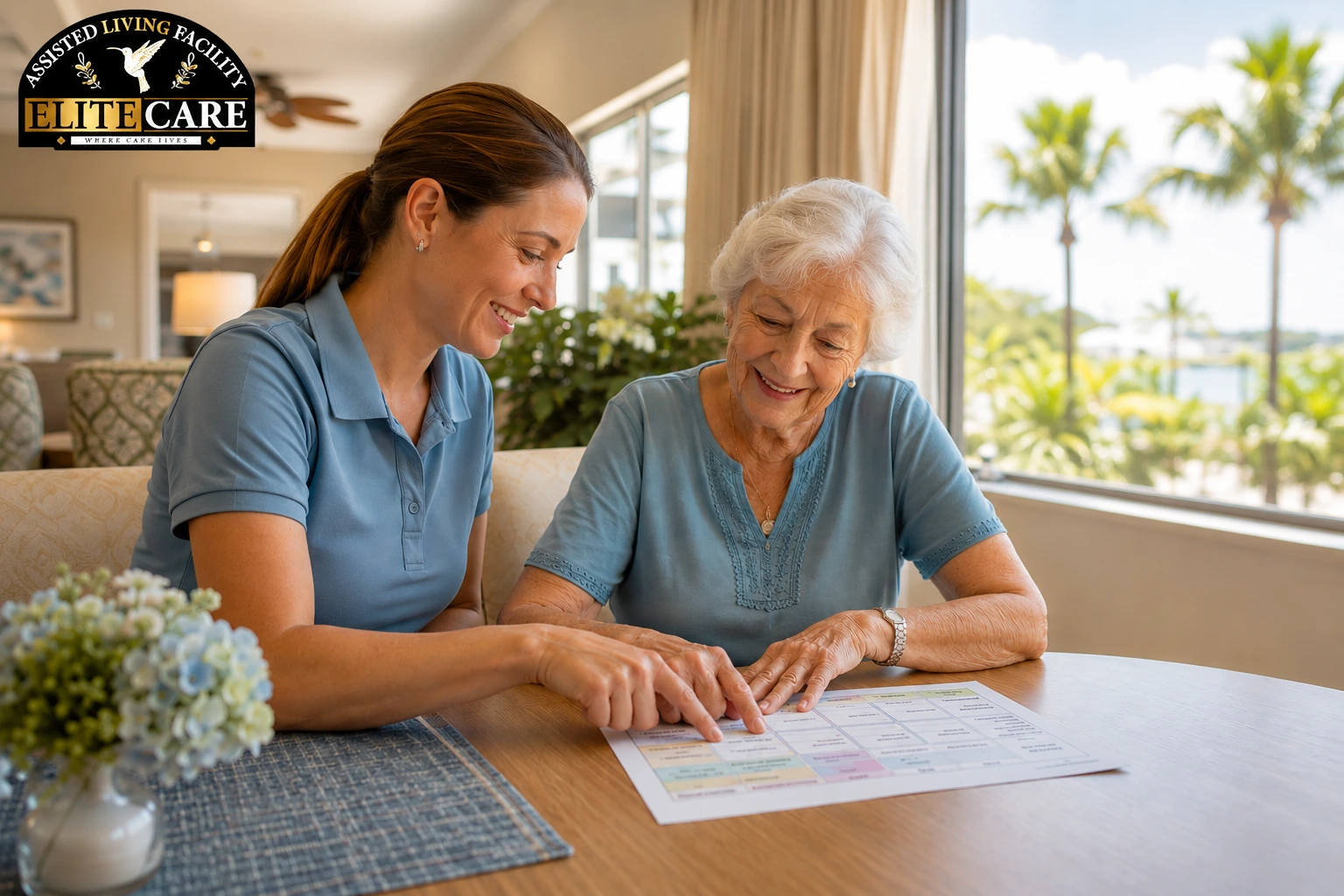
A planner only works if every outdoor slot already has an indoor backup attached — deciding in the moment, once it’s already 95°F outside, is how good intentions turn into a skipped day. Here’s a structure that holds up across a Lakeland summer:
Day
Primary Plan
Heat Trigger
Indoor Backup
Monday
Morning walk (before 9 a.m.)
Heat index 90°F+ by 9 a.m.
Chair yoga
Tuesday
Porch or patio time
Heat index 90°F+
Trivia and brain games
Wednesday
Garden visit
Heat advisory issued
Indoor gardening / arts and crafts
Thursday
Outdoor lunch
Heat index 95°F+
Cooking demonstration
Friday
Community outing
Any heat advisory
Music and sing-along
Weekend
Family visit outside
Heat index 90°F+
Movie afternoon or virtual field trip
The backup isn’t an afterthought—it should be scheduled with the same specificity as the primary plan, including who’s running it and what’s needed, so the switch takes minutes, not a scramble.
A heat safety indoor activity planner helps caregivers prepare these backup activities in advance, ensuring a smooth transition whenever extreme heat makes outdoor plans unsafe.
10 Indoor Backup Activities That Actually Work
These are the activities we rotate through most often when a day flips indoors, as outlined in our heat safety indoor activity planner and ranked by how consistently they hold engagement.
Board games and card tournaments — bingo, dominoes, and rummy adapt to different cognitive levels
Arts and crafts — seasonal projects that support fine motor skills
Music therapy and sing-alongs — reliably reaches residents even with early memory loss
Brain games and trivia — Florida history and local Lakeland landmarks work especially well
Chair yoga and gentle stretching — improves circulation and balance without standing-related fall risk
Cooking and baking demonstrations — sensory engagement plus a hands-on task; pairs well with our approach to meals and nutrition so treats stay occasional
Book club or reading circle — turns a solitary habit into a social one
Indoor gardening — potting herbs near a window keeps the routine alive without the heat exposure
Movie afternoons — an easy, low-effort win on the hottest days
Virtual field trips or guided meditation — a change of scenery for housebound residents
How to Watch for Heat Stress Once You’re Indoors
Air conditioning removes the obvious risk but not all of it — dehydration can still creep up indoors if fluids aren’t offered on a schedule, since thirst sensation is already blunted in many older adults.
The CDC lists the warning signs worth watching for during and after any heat-advisory day: muscle cramping, heavy sweating, dizziness, confusion, nausea, or a rapid pulse. Any of these warrants medical attention right away, not a “wait and see” approach.
A simple habit that catches problems early: offer water at the start of every activity block, not just when someone asks for it.
Common Planning Mistakes Caregivers Make
Waiting for the day to decide. By the time it’s obviously too hot, the backup plan should already be running, not being improvised.
Treating shade as sufficient protection. Shade lowers direct sun exposure but does little against Central Florida’s humidity-driven heat index.
Only planning quiet, seated backups. A week of nothing but passive activities leads to disengagement — the backup plan needs the same physical/creative/social mix as the outdoor one.
Skipping hydration reminders indoors. This is the mistake we see most often, precisely because indoor days feel “safe” by comparison.
Families weighing whether to manage this planning at home or lean on a licensed community often compare assisted living vs. home care in Lakeland at this exact decision point — the day-to-day heat-monitoring workload is one of the more overlooked factors in that comparison.
How Elite Care Runs This Planner Day to Day
At Elite Care, our Activities and Events team checks the local heat index forecast each morning and confirms the day’s plan before residents’ schedules are posted — not after. Residents with memory-related needs get an adapted version of the same planner, since transitions between activities can be harder to manage; our memory care guide for Lakeland covers how that adaptation works in more detail.
For families who need a short-term break from running this system themselves, our respite care for family caregivers puts a loved one into a fully staffed daily program for a few days or weeks. Elite Care is a licensed assisted living facility in Lakeland, FL — you can verify our license and inspection history through the Florida Agency for Health Care Administration.
FAQ About Senior Heat Safety in Lakeland
1. At what heat index should seniors move activities indoors?
Once the forecast heat index reaches 90°F (“Extreme Caution” on the NWS scale) during daytime hours, seniors should move to indoor activities, earlier than the threshold generally used for healthy younger adults.
2.What are the warning signs of heat-related illness in seniors?
Muscle cramps, heavy sweating, dizziness, confusion, nausea, or a rapid pulse any of these calls for immediate medical attention.
3.Why are seniors more at risk from heat than younger adults ?
Many older adults take medications that interfere with the body’s cooling ability or blunt thirst signals, and the body’s natural temperature regulation weakens with age.
4.Do assisted living communities in Lakeland monitor heat advisories?
Yes. Licensed communities like Elite Care check daily heat index forecasts and adjust programming before conditions become risky, rather than reacting after the fact.
5.How is this different from a general list of indoor activities?
A general list gives you ideas; this planner gives you the decision rule for when to use them, tied to actual heat index thresholds rather than guesswork.
Building the Plan Before You Need It
The families who handle Lakeland summers best aren’t the ones scrambling on the hottest afternoon — they’re the ones with a backup already scheduled before the heat index says they need it. Build the planner once, and the rest of the season runs on autopilot.