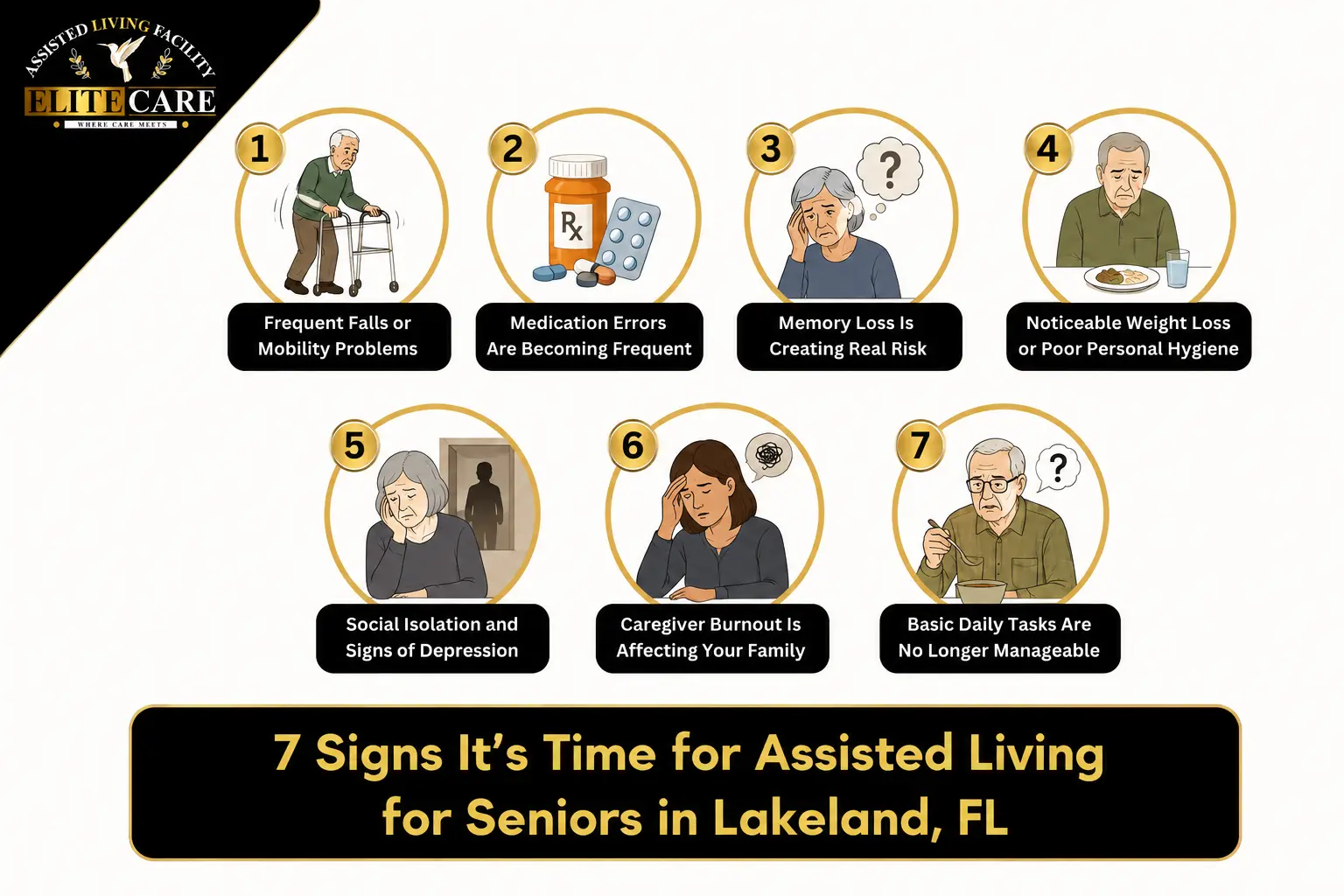
Many families in Lakeland, FL, reach the question of assisted living not through one dramatic moment but through weeks of small worries that quietly grow into real safety concerns. A missed medication here. A fall there. A parent who used to call every day now barely leaves the house.
For many families exploring assisted living in Lakeland FL, these early warning signs are what begin the conversation about daily support and long-term safety.
This guide is for families in Lakeland who are asking the question they have been avoiding. You will learn the seven clearest signs that a senior needs daily support, what to do next, and how local assisted living facilities in Lakeland can help—without pressure and without guilt.
7 Warning Signs Families Should Not Ignore
Frequent Falls or Mobility Problems
Falls are the leading cause of injury-related death among adults 65 and older in the United States, according to the CDC. One fall rarely stays isolated. It creates fear, reduces movement, and leads to faster physical decline.
Watch for:
- Unexplained bruises or injuries
- Holding walls or furniture to walk
- Avoiding stairs or outdoor movement entirely
- Complaints of dizziness or weakness
Assisted living facilities in Lakeland are built with fall prevention in mind — grab bars, non-slip flooring, and trained staff available around the clock.
Medication Errors Are Becoming Frequent
Skipped doses, doubled medications, or missed prescriptions are not small problems. For seniors managing diabetes, heart conditions, or blood pressure, one medication error can trigger a hospitalization.
Signs to watch:
- Pill organizers left untouched for days
- Expired medications still in use
- Confusion about which medication is for what
- Missing scheduled refills
Senior care in Lakeland that includes professional medication management removes this risk entirely. Caregivers track every dose, every day.
Memory Loss Is Creating Real Risk
Forgetting a name is normal. Forgetting the stove is on, or getting lost driving a familiar road, is a warning sign.
Many seniors with early cognitive decline do well in assisted living—consistent routine, social engagement, and supervised safety provide strong support. The concern rises when memory loss begins creating physical danger.
Key signals:
- Wandering outside alone, especially at night
- Leaving gas burners or appliances unattended
- Repeating the same conversation within minutes
- Confusion about dates, people, or basic daily sequence
Note: If memory loss is advanced, memory care may be more appropriate than standard assisted living. See the comparison section below.
Noticeable Weight Loss or Poor Personal Hygiene
These two signs are often the most visible — and the most ignored by families who do not want to confront what they mean.
Weight loss happens when cooking becomes too difficult, grocery shopping is skipped, or appetite drops due to isolation. Poor hygiene follows when bathing, dressing, or grooming becomes physically or cognitively out of reach.
Watch for:
- Wearing the same clothes for multiple days
- Strong body odor or visibly unwashed hair
- Significant unexplained weight loss over weeks
- A refrigerator full of expired or untouched food
Assisted living for seniors includes daily hygiene assistance and three nutritious meals—handled with dignity, not clinical coldness.
Social Isolation and Signs of Depression
Loneliness in seniors is not a mood. Research published by the National Institute on Aging links chronic isolation directly to cognitive decline, cardiovascular risk, and earlier mortality.
Signs your parent may be struggling socially:
- Has stopped attending church, clubs, or community events
- No longer calls friends or family
- Expresses hopelessness or disinterest in daily life
- Spends most of the day in one room, doing very little
Senior living in Lakeland FL offers daily structured activities, shared meals, group outings, and consistent human connection. For many residents, this is the change that brings them back to themselves.
Caregiver Burnout Is Affecting Your Family
This sign is about you — and it belongs on this list.
Family caregivers who take on full daily responsibility for a senior parent often do so quietly, absorbing exhaustion, stress, and personal sacrifice until something breaks. Caregiver burnout is a documented health condition, not a personal failing.
Honest signals to acknowledge:
- You are losing sleep due to worry or nighttime care demands
- Your work, relationships, or health are visibly suffering
- Arguments at home center around caregiving responsibilities
- You feel resentment—and then guilt for feeling resentment
Choosing elderly care in Lakeland is not abandonment. It is a decision that protects both your parent and you.
Basic Daily Tasks Are No Longer Manageable
Activities of daily living — bathing, dressing, cooking, cleaning, laundry, and transportation — are the foundation of independent life. When two or more become consistently unsafe or impossible, the level of care needed has shifted.
Daily task warning signs:
- The house is consistently unkempt from someone who was always tidy
- No ability to prepare meals safely
- Cannot manage transportation to medical appointments
- Bills going unpaid or important mail unopened
Senior assistance with daily living is central to what assisted living provides. Restoring this structure consistently improves quality of life within weeks.
Assisted Living vs Nursing Home: What Is the Right Choice?
This is one of the most searched comparisons in senior care—and the distinction is important for making the right decision.
Assisted Living:
- For seniors needing daily support but not continuous medical care
- Home-like environment with independence preserved
- Covers personal care, meals, medications, activities, and safety
- Appropriate for most seniors showing the signs above
Nursing Home (Skilled Nursing Facility):
- For seniors requiring continuous clinical or medical care
- Post-surgical recovery, advanced illness, or complex conditions
- More institutional, higher level of medical oversight
Memory Care:
- Specialized unit for seniors with moderate to advanced dementia
- More structured and secured than standard assisted living
- Not always necessary for early cognitive decline
For most families in Lakeland, assisted living is the right starting point. Nursing home placement is appropriate only when medical needs exceed what assisted living can manage.
What to Expect From Assisted Living Facilities in Lakeland
Quality senior living in Lakeland, FL, typically includes
- 24-hour awake staff supervision
- Medication administration and tracking
- Three daily meals with dietary accommodations
- Personal hygiene and grooming assistance
- Housekeeping and laundry services
- Scheduled social activities and light exercise programs
- Transportation coordination for medical appointments
- Regular family communication and care plan updates
- Emergency response protocols with local service coordination
When comparing facilities, ask specifically about staff-to-resident ratios, how care plans are updated over time, and what the visiting policy looks like. Florida licensed ALFs are regulated by the Agency for Health Care Administration (AHCA)—confirm licensing before committing.
Why Families in Lakeland Trust Local Assisted Living Over Large Chains
This matters more than most families realize when beginning their search.
Large corporate facilities often operate with high resident volumes, standardized care templates, and staff turnover rates that affect consistency. Local assisted living providers in Lakeland tend to offer smaller resident populations, longer-tenured caregivers, and care decisions made by people who know your parent by name — not by room number.
Factors that build genuine trust in a facility:
- Active AHCA licensure with a clean inspection history
- Low staff-to-resident ratio (ideally 1:6 or better for assisted living)
- Family involvement in care planning from day one
- Transparent, itemized pricing with no surprise add-on billing
- Willingness to offer a short-term or respite stay before full commitment
Florida’s senior population is among the largest in the country, and Lakeland’s growing community of elderly care providers reflects that. The options available today are meaningfully better than even five years ago — both in quality and in affordability.
How Lakeland’s Environment Supports Senior Wellbeing
Lakeland’s year-round warm climate is not just a quality-of-life bonus—it has measurable health relevance for seniors. Regular outdoor exposure supports vitamin D production, improves mood, and encourages light physical activity that preserves mobility.
Lakeland also sits within reasonable proximity to strong healthcare infrastructure, including Lakeland Regional Health, one of the largest hospitals in Central Florida. Assisted living facilities that coordinate with this network give families additional confidence that escalating medical needs can be managed without disruptive transfers between facilities.
The combination of climate, community, and healthcare access makes senior care in Lakeland, FL, a genuinely strong option for families across Polk County.
Frequently Asked Questions
1. At what age is it best to move to assisted living? There is no fixed age — the decision is based on care needs. Most residents are in their late 70s or 80s, but earlier placement is increasingly common when safety risks are present.
2. How much does assisted living cost in Lakeland, FL? Monthly costs typically range from $2,500 to $4,500, depending on room type and care level. Some facilities accept Medicaid or offer flexible payment plans.
3. Is assisted living better than a nursing home for most seniors? For seniors who do not need continuous medical care, yes—assisted living offers more independence, comfort, and quality of life at a lower cost.
4. Can a senior with early dementia live in assisted living? Yes. Mild to moderate cognitive decline is well-supported in assisted living. Advanced dementia typically requires dedicated memory care.
5. What is included in a standard assisted living plan? Most plans include meals, personal care, medication management, housekeeping, activities, and 24-hour supervision. Always request a written service list before signing.
Conclusion
The seven signs covered here — from falls and medication errors to isolation and caregiver burnout — are not reasons for guilt. They are information. Acting on them early gives your family more choices, more time, and far fewer crises.
If your loved one is showing several of these signs, exploring assisted living in Lakeland, FL, now is the most responsible thing you can do for them.
Ready to Explore Assisted Living in Lakeland, FL?
Recognizing the signs is the first step. Taking action is what protects your loved one.
At Elite Group Care, Lakeland families have trusted over 20 years of personalized senior care — licensed by the Florida Agency for Health Care Administration (AHCA License #14006) and designed around each resident’s individual needs, not a one-size-fits-all plan.
What a free consultation includes:
- Guided tour of the assisted living community
- Honest conversation about your loved one’s specific care needs
- Clear breakdown of available care options and costs
- A no-pressure setting where your questions actually get answered
Serving Lakeland, Winter Haven, Bartow, Auburndale, and surrounding Polk County communities.
Schedule Your Personalized Care Consultation Today
Call: 863-333-0311
Email: elitegroupcare@gmail.com
Visit: 6017 Christina Dr E, Lakeland, FL 33813
Career:https://elitegroupcare.com/career/
📱 Follow Us: Facebook | Instagram
Elite Group Care — Compassionate Assisted Living in Lakeland, FL.