Independent living vs assisted living comes down to who handles daily care. Independent living suits seniors who manage their own routines; assisted living suits seniors who need hands-on help, medication support, and staff on-site overnight. Families in Lakeland usually face this choice after a fall, a missed dose, or a caregiver running out of hours.
This guide compares Florida costs side by side, shows where paid home care outgrows assisted living, and ends with a 10-question check for your parent.
It is written for adult children and spouses in Lakeland and Polk County weighing the options for someone they love.
At Elite Care Assisted Living, we meet families at exactly this fork, often after a scare. We specialize in assisted living, not independent living, so we provide an honest comparison even when another option may be more suitable. If you would rather talk it through, you can request a free care assessment at any point.
What is the difference between independent living and assisted living?
Independent living gives active seniors a maintenance-free home and a social life. Assisted living adds personal care, medication management, and 24/7 staff for people who can no longer do every daily task safely alone. The difference between independent living and assisted living is hands-on help with activities of daily living (ADLs) such as bathing, dressing, toileting, and eating. That is why independent living vs assisted living is mostly a question of daily help, not housing style.
Independent living
Assisted living
Best for
Active seniors who manage their own care
Seniors who need regular help with ADLs
Personal care
Not included; some communities sell add-ons.
Included, based on a written care plan
Medication management
Residents handle their own
Staff assist, remind, or administer.
Staffing
Property and activity staff
Trained caregivers on site 24/7
Meals
Often one or more meals per day
Typically three meals plus snacks
Housing
Private apartment, often a 55+ community
Private or shared room with common areas
Cost model
Monthly rent; Life Plan Communities add an entrance fee.
Monthly rate that rises with level of care
Florida oversight
Not licensed as an assisted living facility unless it provides personal services
Licensed by the Agency for Health Care Administration (AHCA)
What is independent living?
Independent living is senior housing for adults who need no daily personal care but want to stop maintaining a home. Residents have their own apartments and access to shared amenities and services. In short, what is independent living? A home with services, not a care setting. It is also called senior apartments, a retirement community or a 55+ community.
Typical inclusions:
A private apartment with a kitchenette
Housekeeping, laundry, and maintenance-free living
Some meals, plus scheduled transportation
A social calendar and an emergency call system
Independent living does not include bathing help, medication management, or overnight caregivers. A Life Plan Community (also called a CCRC) offers independent living, assisted living, and skilled nursing on one campus, usually for an entrance fee plus a monthly fee. That structure is a continuum of care under one roof.
Can residents of independent living get care?
Only through add-on services or outside home care; the community itself does not provide personal care. Many families hire a private caregiver by the hour. That works for light needs and gets expensive as hours grow, as the cost comparison below shows. If your parent already needs help bathing or with medication, that is usually the cue to look at assisted living.
What does assisted living include in Florida?
Assisted living in Florida provides housing, meals, and personal services to adults who need help with daily life but not 24-hour skilled nursing. So what does assisted living include? Our assisted living services cover the same core list most Florida communities offer:
Personal care: bathing, dressing, grooming, and toileting support
Medication management and routine health monitoring
Caregivers on site 24/7, with an emergency call system
Three meals a day built around dietary needs
Housekeeping, laundry, activities, and transportation
Florida defines an assisted living facility in Chapter 429 of the Florida Statutes as a place that provides housing, meals, and one or more personal services to adults. These facilities are licensed by the Florida AHCA, and you can look up a facility and its AHCA reports on FloridaHealthFinder. Some licensed communities can also provide limited nursing services, such as routine dressing changes. Ask any community what its license covers.
How do independent living vs assisted living differ day to day?
The difference shows up in four places: who helps, who notices a problem, where your parent sleeps, and how involved the family needs to be.
Who helps with bathing, dressing, and medication?
In independent living, your parent does, or the family arranges outside help. In assisted living, a caregiver follows a care plan built from a care assessment. The plan is reviewed as needs change, which is what makes assisted living a level of care and not just a nicer apartment.
Who notices a problem at 3 a.m.?
In many independent living communities, overnight staff handle emergencies only; an assisted living caregiver can help your parent up, check on them, and follow the care plan. Most comparison pages skip this, so ask both types of community who is awake overnight and what they are allowed to do.
If your parent has had a fall or has a high fall risk, this answer matters more than the amenities list.
What do rooms and privacy look like?
Independent living means a full apartment. Assisted living means a private or shared room with a bathroom, plus common areas. Privacy is a common worry, so ask whether a private room is available and how it is priced. See our living accommodations page for room types.
Can couples stay together if only one needs care?
Often yes, but it depends on the community. Some assisted living communities offer shared or adjoining rooms, so ask early. Furniture usually comes along; car and parking policies vary, so ask the community directly.
How do meals and activities compare?
Both offer dining and social calendars. Assisted living programming is usually shaped around mobility and cognition, so someone with arthritis or early memory loss can still take part. Independent living calendars lean toward trips, clubs, and classes.
How involved does the family stay?
In independent living, family often acts as the care coordinator. In assisted living, the care team carries daily tasks, and the family moves back into the role of son, daughter, or spouse. That shift often relieves caregiver strain, which we cover in how assisted living reduces caregiver burnout.
How much does independent living vs assisted living cost in Lakeland?
In Florida, independent living averages roughly $2,400 to $3,300 per month, while the median assisted living community costs about $5,500 per month. The independent living vs assisted living cost gap exists because assisted living bundles meals, care, and 24/7 staffing into one rate.
CareScout hourly rate calculated from the annual figure
These are statewide numbers. Polk County prices can differ from the state median, and every community sets its own rates, so treat them as a planning range and ask for written quotes. Elite Care sets rates after a care assessment, so contact our team for current pricing.
When does independent living plus home care cost more than assisted living?
Using Florida median rates, the crossover is about 19 hours of home care per week. Many families keep a parent in independent living and add a paid caregiver. That works until the hours climb.
Weekly home care hours
Home care per month
Plus independent living (about $2,900)
Assisted living median
10 hours
About $1,390
About $4,290
About $5,500
20 hours
About $2,770
About $5,670
About $5,500
30 hours
About $4,160
About $7,060
About $5,500
This is our calculation from the figures above. With independent living at $2,400, the crossover moves to about 22 hours, and at $3,300 to about 16. Hourly care also does not cover nights, so the real gap is wider for anyone who needs overnight oversight. Our comparison of assisted living vs home care in Lakeland goes deeper on local hourly rates.
Does Medicare pay for independent living or assisted living services?
No. Medicare treats independent living vs assisted living the same way: it does not pay for room and board, so both are mostly paid privately. Medicare covers limited medical services, such as a short skilled-nursing stay after a qualifying hospital visit. Independent living has almost no public funding, since it is housing. Assisted living has a few more options:
Florida Medicaid long-term care (SMMC LTC): may cover care services for eligible seniors, not room and board
VA Aid and Attendance: a pension supplement for qualifying veterans and surviving spouses
Long-term care insurance: often covers assisted living, rarely independent living
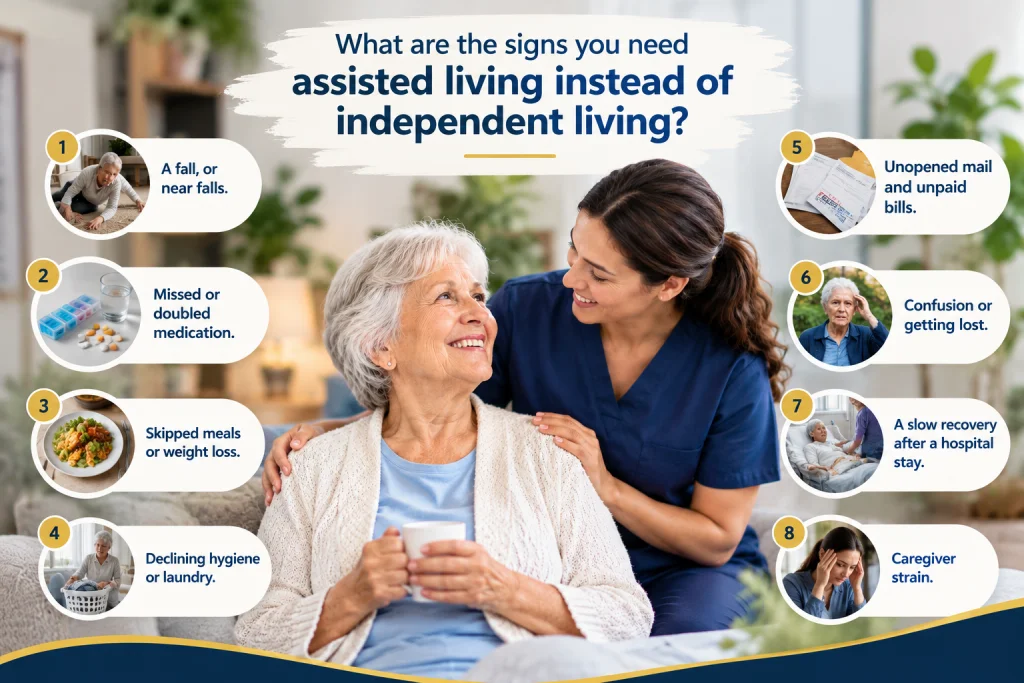
What are the signs you need assisted living instead of independent living?
The main signs are falls, missed medication, weight loss, declining hygiene and caregiver strain; if two or more apply, independent living is probably no longer enough. These are the signs you need assisted living, listed roughly in order of urgency:
A fall, or near falls. Even one fall is a warning sign. Look for bruises and for furniture being used as a handrail.
Missed or doubled medication. Look at the pill organizer, not the answer you get on the phone.
Skipped meals or weight loss. An empty fridge or expired food is a clear signal.
Declining hygiene or laundry. Wearing the same clothes or avoiding the shower, often hides a mobility or balance fear.
Unopened mail and unpaid bills. This points to memory or executive-function trouble.
Confusion or getting lost. If wandering or repeated questions are part of the picture, ask about memory care.
A slow recovery after a hospital stay. Short-term need often becomes long-term need.
Caregiver strain. If the family is covering the gaps, the plan has already stopped working.
Three or more yes answers about your parent’s last 30 days means it is time for a care assessment; six or more points to assisted living now. Answer yes or no to each question below. For most families, this check settles independent living vs. assisted living.
Have they fallen or nearly fallen?
Have they missed or repeated a medication?
Do they need help bathing or dressing?
Are they skipping meals or losing weight?
Is the home noticeably less clean or safe?
Are bills or mail going unattended?
Do they seem lonely or withdrawn?
Have they been in the hospital or ER?
Is family helping more than 10 hours a week?
Does anyone worry about them being alone overnight?
0 to 2 yes: independent living is likely fine. Recheck in three months. 3 to 5 yes: get a care assessment and compare costs. 6 or more yes: assisted living is likely the right level of care now.
When is it time to move from independent living to assisted living?
When to move from independent living to assisted living comes down to this: move when care needs outgrow what the apartment and any add-on help can safely cover, ideally before a crisis. Waiting for a fall or hospital stay forces an independent living vs assisted living decision in a hurry, with fewer options. Planning keeps the decision with your parent.
If your parent is in a Life Plan Community, the move may be to another wing of the same campus. In a standalone independent living community, it usually means a new address, so tour assisted living options early. Aging in place works only when the help arrives at the same hours the need does.
Not sure yet? A short respite stay lets your parent try assisted living, and lets you see how they respond to daily support, before committing to a permanent move.
What should you ask on a tour?
Use these six questions when comparing independent living vs assisted living communities, ours included. Our full guide to assisted living tours in Florida covers the rest.
Is the community licensed by AHCA, and are its latest inspection reports available for review?
Who is on duty overnight, and what can they do?
What circumstances may require a transition to a higher level of care?
How and when do rates increase?
What is the staff-to-resident ratio on days, evenings and nights?
How do you assess care needs before move-in and afterward?
What does independent living in Lakeland, FL look like?
Independent living in Lakeland, FL is mostly apartment-style senior housing, and searches for it return directories and a short list of communities. Families weighing independent living vs. assisted living should know what that housing does and does not include. Most offer an apartment, some meals, activities, and transportation, but not personal care. Prices, age limits, and fees differ, so request a written fee sheet before touring.
The most useful single question to ask is whether the community also offers assisted living, or a partner nearby. If it does not, a change in your parent’s health means a second move.
How do you evaluate senior independent living in Lakeland, FL?
Judge senior independent living in Lakeland, FL by what happens when needs change, not by the amenities list. Weigh independent living vs assisted living on a tight timeline by checking four things:
License and services: confirm what the community is and is not licensed to provide
Add-on care: ask who provides it, at what hourly rate, and whether overnight help is available
Transition plan: ask how a move to assisted living works and how much notice you get
Total monthly cost: add rent, meals, fees and any care you would need to buy
Why do Lakeland families choose Elite Care Assisted Living?
Families choose Elite Care Assisted Living for 24/7 caregivers, personalized care plans and a homelike setting in Lakeland, with clear answers about cost and care level. Here is what that looks like in practice:
Personalized care plans built from a care assessment and updated as needs change
Private or shared rooms with common areas designed for comfort and community
A dietary team that works with residents’ physicians on meal plans
Licensed care with limited nursing services where residents need them
Honest guidance on whether assisted living is the right fit yet
Our team is also happy to say when assisted living is not the answer yet. In an independent living vs assisted living decision, we would rather you wait than move too early.
Conclusion: independent living vs assisted living, which one is right?
Choose independent living while your parent manages daily care alone and safely. Choose assisted living when help with bathing, medication or nights becomes part of the routine. Independent living vs assisted living is a question of care needs first and price second.
Three points to carry with you:
Care needs decide the level. Falls, missed medication and weight loss signal that independent living is no longer enough.
The cost line is about 19 hours. Beyond that, assisted living usually costs less and offers more oversight.
Timing protects choice. Moving before a crisis keeps the decision in your parent’s hands.
Ready to find the right level of care for your parent?
You do not have to decide alone, and you do not have to decide today. A free care assessment with Elite Care Assisted Living is a calm conversation about your parent’s routines, health and budget. You leave with an honest answer on independent living vs. assisted living, including a clear “not yet” if that is the truth.