Elite Care Assisted Living Facility in Lakeland, FL builds every resident’s dining experience around a personalized nutrition plan, not a fixed menu. Our licensed dietary team works directly with residents’ physicians, so meals double as a medical and quality-of-life service, not just food service.
This guide breaks down exactly how that works: how meals get personalized, how comfort food is handled without losing its comfort, how dining functions as a social program, and how we manage complex dietary needs. If you’re comparing assisted living services in Lakeland and want a real look at a dining program before you tour, start here.
Want to see a sample weekly menu in person?Schedule a tour and taste it for yourself.
Why Do Seniors in Assisted Living Need a Specialized Dining Program?
Because nutritional needs shift sharply after 65, while appetite typically drops—so a generic menu works against residents, not for them.
Muscle mass declines. Bone density drops. Chronic conditions like diabetes, hypertension, and heart disease become more common. At the same time, the body’s need for calcium, vitamin D, protein, and fiber goes up even as appetite goes down.
Left unmanaged, that gap shows up as:
Dehydration, which is often missed in seniors and can trigger confusion, UTIs, or hospitalizations, affects seniors’ health outcomes. For families researching assisted living care options in Lakeland, FL, understanding the depth of a facility’s dining program is one of the most important questions to ask.
Increased fall risk from muscle weakness and poor balance
Slower wound healing after illness or surgery
Cognitive decline, including memory and concentration issues
How Does Elite Care Personalize Meal Plans for Each Resident?
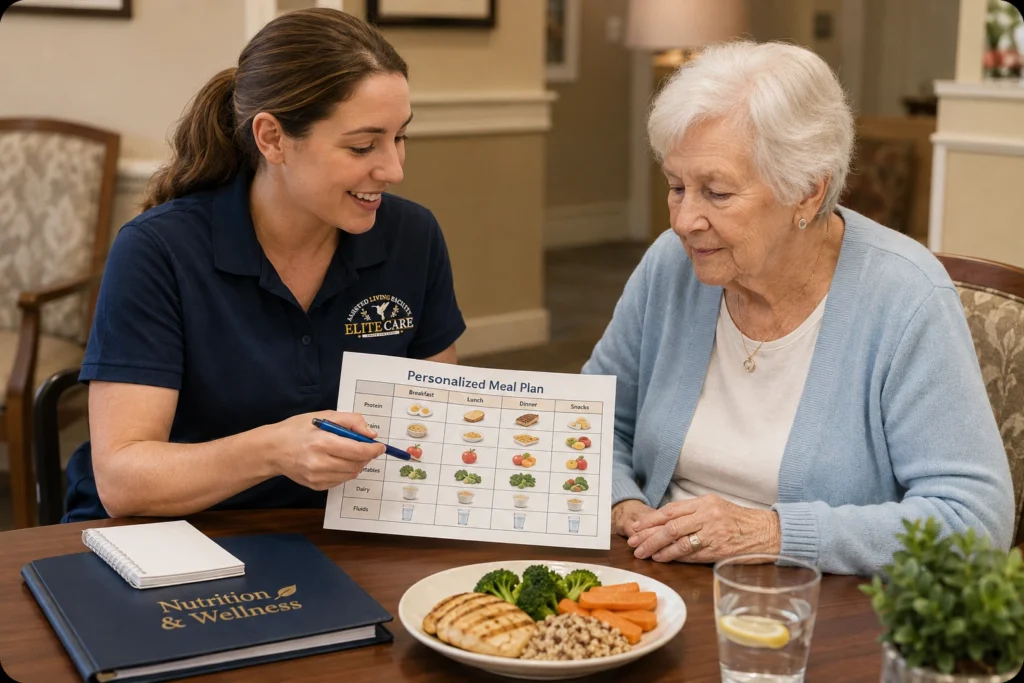
Every resident gets a dietary assessment within their first week, built with their physician and family, then adjusted as needs change.
Generic cafeteria dining has no place in quality senior care. Here’s what personalization actually covers:
Medical conditions
Diabetic-friendly menus with controlled carb distribution across meals
Low-sodium, heart-healthy options for hypertension or congestive heart failure
Renal-appropriate meals limiting potassium and phosphorus for kidney disease
Anti-inflammatory choices for arthritis or autoimmune conditions
Have a loved one with dietary restrictions or a swallowing concern?Talk to our care team before move-in so the plan is ready on day one.
What Do Comfort Foods Look Like in a Health-Focused Senior Dining Program?
The classics stay on the menu, rebuilt to support health goals without losing the flavor residents grew up with.
Familiar food triggers positive memory, reduces anxiety, and stimulates appetite in residents who might otherwise eat too little. Our culinary team recreates comfort staples with real nutritional upgrades:
Classic Comfort Food
Elite Care’s Version
Fried chicken
Herb-baked chicken with olive oil — crisp without the saturated fat
White pasta casserole
Whole-grain pasta bake with added vegetables and lean protein
Cream-based soups
Pureed vegetable soups on low-sodium broth, same creamy texture
Sugar-heavy desserts
Fresh fruit cobblers, Greek yogurt parfaits, date-sweetened treats
Mashed potatoes
Cauliflower-potato blend, fortified with calcium and vitamin D
The goal isn’t to disguise healthy food as a treat. It’s for residents to get the taste and comfort of decades-old favorites while the plate quietly does its job.
Why Does Mealtime Function as a Social Program, Not Just Food Service?
Because isolation is one of the biggest health risks in senior living, and shared meals are one of the most natural ways to counter it.
Our dining spaces are built as social environments, not just serving stations:
Round and rectangular community tables that encourage conversation
Scheduled themed dining events — holiday meals, cultural food nights, birthday celebrations — that residents look forward to
Family dining invitations, so loved ones can join a resident for a meal and keep that bond active
Staff sitting with residents at the table rather than only serving, which builds genuine connection
For residents who prefer solitude, due to personality, recovery, or health status, private and in-room dining is available with the same food quality and full dignity. Shared meals are one reason socialization matters so much for seniors in assisted living, and dining is where that plays out daily.
How Does Elite Care Handle Advanced or Complex Dietary Needs?
Through direct coordination with residents’ physicians and dietitians, covering everything from allergy protocols to enteral nutrition support, without residents or families managing it alone.
Some residents arrive with dietary needs that go well beyond a modified menu. Here’s how that’s handled:
Allergy and intolerance management
Full allergen tracking built into the meal planning system
Separate preparation protocols to prevent cross-contamination
Regular allergy reviews as a resident’s health status changes
Enteral nutrition and tube feeding support
For residents who can’t meet nutritional needs orally, our team coordinates tube feeding protocols directly with treating physicians and, where needed, outside nursing or home health providers
Oral nutritional supplementation, including high-calorie shakes and protein supplements, is added when clinically appropriate
This is advanced dietary care delivered inside an assisted living setting, coordinated with the same clinical rigor a family would expect from any nursing-level care plan, without residents needing to relocate to a skilled nursing facility for routine support
Weight management, both directions
Underweight residents get high-calorie, nutrient-dense plans to support healthy weight gain
Residents at risk of obesity-related complications get portion-balanced, satisfying meals for gradual, safe management
Monitoring and adjustment
Dietary intake is tracked and documented
Unexplained weight loss or gain triggers an immediate dietitian review
Families are updated when significant changes occur
This oversight is part of our broader commitment to specialized dietary and medical care, and for residents approaching end of life, dietary comfort care is coordinated closely with our hospice care team as well.
What Should Families Ask About a Senior Dining Program When Touring?
Ask to see a real menu, ask how restrictions are documented, and ask what happens the moment a resident stops eating normally.
Can I see a sample weekly menu? It should show real variety and evidence of nutrition planning, not rotating institutional staples.
How are dietary restrictions communicated to kitchen staff? There should be a documented system, not a verbal chain that breaks down on a busy shift.
What happens if a resident stops eating or loses significant weight? There should be a defined clinical response, not a wait-and-see approach.
Are residents involved in menu feedback? Satisfaction should be actively tracked, and menus adjusted based on it, not set once and left alone.
At Elite Care Assisted Living Facility, food is an expression of the respect we have for every resident, backed by licensed dietary oversight, not just a kitchen schedule. Personalized plans, real comfort food, genuine social dining, and clinical-level support for complex needs are what separate a real dining program from a menu board.
📍 6017 Christina Dr E, Lakeland, FL 33813 📞 863-333-0311
FAQs
What makes assisted living dining different from a typical senior living menu?
Every resident gets a personalized dietary assessment tied to their medical conditions, swallowing ability, and preferences, not a fixed menu everyone eats from.
Can Elite Care accommodate diabetic, low-sodium, or renal diets?
Yes, meal plans are built around each resident’s specific medical conditions, including diabetic, heart-healthy, and renal-appropriate menus.
Does Elite Care support tube feeding or enteral nutrition?
Yes, the dietary team coordinates tube feeding and oral nutritional supplementation directly with residents’ physicians when clinically needed.
Can residents eat in their room instead of the dining hall?
Yes, private and in-room dining is available with the same food quality and full dignity for residents who prefer it.
How are family members involved in a resident’s meal plan?
Families help shape the initial dietary assessment and are updated whenever a dietitian flags a significant weight or health change.
Elite Care Assisted Living – Lakeland, FL
At Elite Care Assisted Living Facility, food is an expression of the respect and love we have for every resident. By combining clinical nutrition expertise with genuine culinary care and a warm, community-centered dining environment, we provide a mealtime experience that supports health outcomes, emotional well-being, and the simple daily joy of a good meal shared with people who care.
If your family is evaluating senior living options in Lakeland, FL, and nutritious, personalized dining is a priority, we’d love to show you what we do.